Asking for it in the prompt is not a guardrail
Writing "do not cancel subscriptions" in the instructions is a request, and a model can ignore it given a strange enough conversation.
The guardrail is that the cancel tool is not available, or that it requires human confirmation. The first is an intention; the second is a limit.
Why it matters
Because an agent connected to your API can do things with consequences, and the difference between an incident and a scare is whether the limit was in the code or in a sentence.
It is also the first thing the security team of any mid-sized customer asks about.
Input, output and action guardrails
They are classified by the moment they act.
A chatbot that only answers needs the first two. An agent connected to the company’s systems needs all three.
- Input. They check what reaches the model, such as an off-topic request, a message trying to override the instructions (prompt injection) or personal data that should not be passed on.
- Output. They check the answer before anyone sees it, looking for a fact that is not in the sources, a promise the company cannot keep or content that breaks policy.
- Action. They decide which tools the system can call at all and which ones wait for a person to confirm.
The three levels
What it can read, what it can write and what it can say.
The first is controlled with permissions, the second with which tools you expose plus confirmation on anything irreversible, and the third by reviewing outputs.
Examples in customer support
The ones almost any company needs from day one.
- The agent answers only from the company’s own content and says so when the answer is not there.
- It can look up an invoice but cannot issue a refund.
- It never quotes a price or a deadline that is not written in a source.
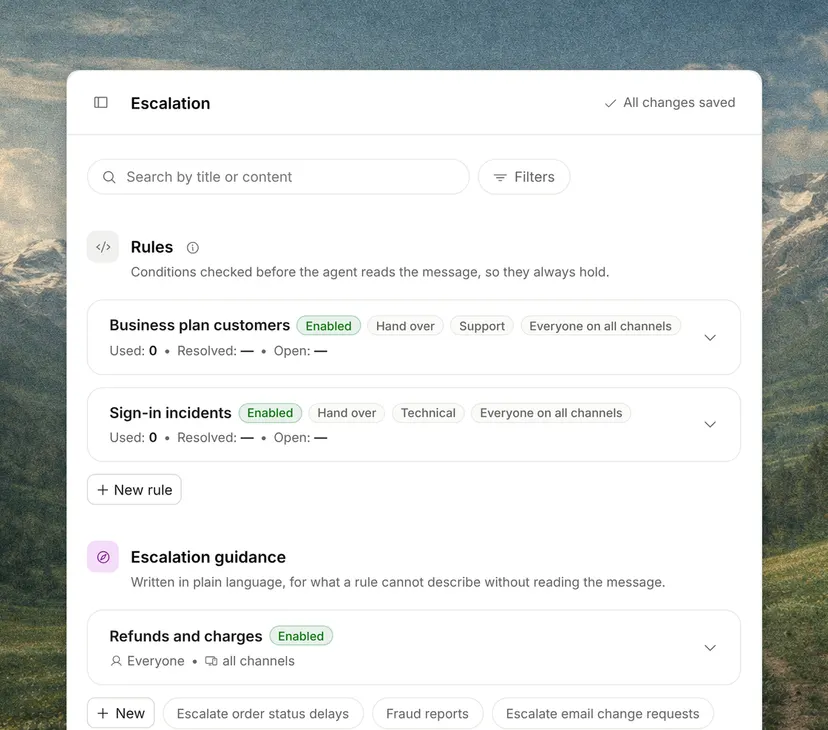
- Legal threats, complaints about a person and cancellations go straight to the team.
- Data from one customer never appears in a conversation with another.
How to test them
Write the conversations that should trip each guardrail and run them before every change to the agent.
A refund request outside the policy, a message that says "ignore your instructions", a question the documentation does not answer. A guardrail nobody has tested is an assumption. After launch, read the conversations where the agent refused or handed off, because that is where you see whether the limits sit in the right place.
Separate reading from writing
It is the line that pays off most.
Looking up a plan breaks nothing; changing it does. Starting by exposing reads only resolves a good share of conversations at no risk, and leaves writes for when there is confidence.
Irreversible things go through a person
Canceling, deleting, refunding.
Even if the agent is wrong no more often than a person, when it is wrong there will be nobody watching to notice in time.