The word "agent" means two things now
In support, "agent" used to mean the person answering.
Since 2023 it also means the software that answers without anyone involved. Say "AI agent" for the second one. Both live in the same team, and sentences like "the agent hands it to the agent" help nobody.
Why it matters
It is the difference between resolving and forwarding.
A system that only generates text can explain anything that is written down; one that also reads and acts can close the case. In a SaaS, where many questions depend on each customer’s plan, permissions or usage, that difference decides whether support volume drops at all.
AI agent, chatbot and copilot, the differences
All four hold a conversation.
What changes is where the answer comes from, what they can do and who they work for.
- Rule-based chatbot. Follows a hand-written decision tree and does not understand anything outside it.
- Docs chatbot. Answers from what it finds in the documentation, the same for every customer.
- AI agent. Also checks the account data and takes actions, within the limits it is given.
- Copilot. Works for the person on the team, drafting the reply for them rather than answering the customer.
The three pieces
A language model that writes, a way to retrieve information (your documentation and the account state) and a set of tools it can call.
Remove the third and you have a chatbot; remove the second and you have a text generator that makes the data up.
What you decide when you set it up
What it may read and what it may do.
That is a product conversation, not a configuration screen. "It can check the plan and the usage, it can resend an invoice, it cannot cancel a subscription." Skipping that decision is what produces agents that answer strange things.
Knowing when to stop
An agent that always answers is worse than one that recognizes its limit.
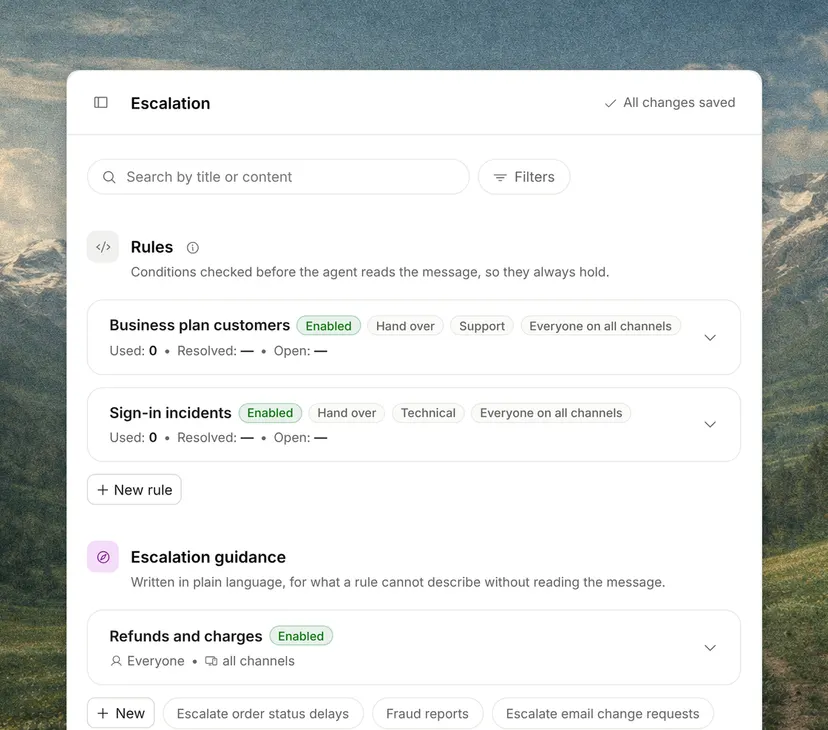
When the data does not add up, when judgment is needed or when the customer asks, the right move is to hand the conversation to a person with the case assembled.
How it is priced
This category usually charges per conversation or per resolved conversation rather than per seat, because the system does not occupy a desk.