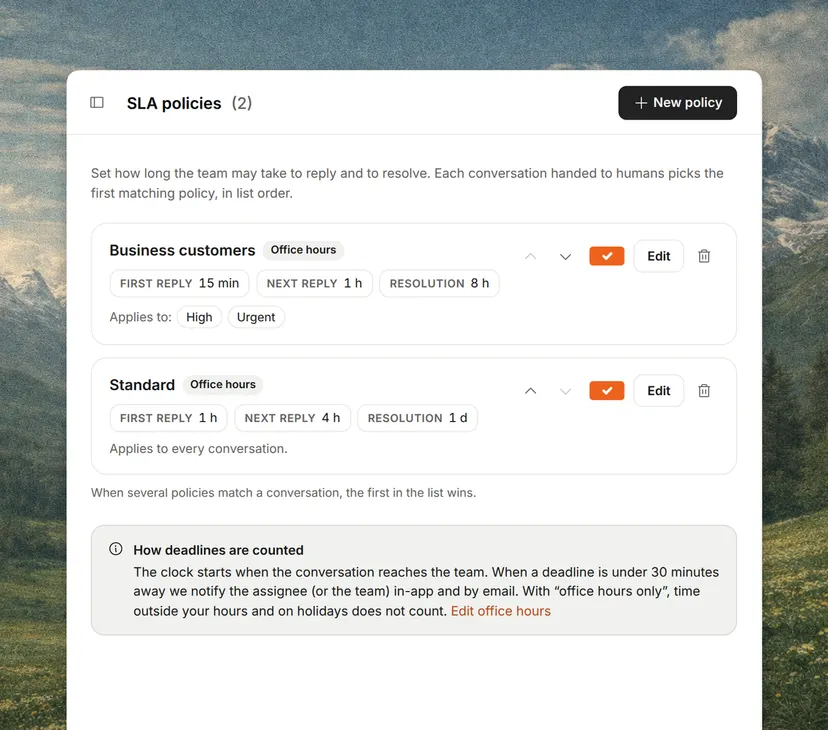
Response, first response and resolution
Response time is the general name.
First response time measures only the initial wait. Next response time measures each later wait within the same conversation. Resolution time runs from when the request arrives until it is resolved. A team can reply quickly and resolve slowly, and customers notice both.
Why it matters
The wait is the first thing a customer judges and the thing they remember most.
A correct answer that arrives late feels like poor service, and a wait with no news pushes people to write on another channel, which doubles the work. It is also the figure an SLA commits to.
How it is calculated
Response time is calculated by subtracting the time of the customer’s message from the time of the reply, and summarised with the median for the period.
The figures in the example are illustrative.
- Example. If five conversations wait 5, 10, 12, 20 and 240 minutes, the median is 12 minutes and the mean is 57.
- Why the median. One forgotten conversation drags the mean and hides how most customers are served.
- The percentile. The longest wait for 90% of customers shows the tail the median cannot see.
The three times
Three different times are worth measuring, because each fails for a different reason.
| Time | What it measures | What a high value points to |
|---|---|---|
| First response | The initial wait | Too little capacity or assignment at intake |
| Next response | Each later wait | Conversations left without an owner |
| Resolution | Until it is resolved | Cases that depend on other teams |
What customers expect on each channel
Expectations depend on the channel, which is why the deadline is set channel by channel.
- Chat and phone. A reply there and then, while the customer waits.
- Messaging. A reply within the day. On WhatsApp, also inside the 24-hour window.
- Email. A reply within hours, during service hours.
What counts as a reply
An automatic acknowledgement is not a reply, because it deals with nothing.
An answer that resolves does count, whether a person or an AI agent gives it. You also need to decide whether the clock runs only during service hours and write that down.
The deadlines in Spanish law
For companies in its scope, Spain’s Law 10/2025 requires 95% of requests for personal service to be answered, on average, in under three minutes.
Its Article 17 also sets a maximum of fifteen working days to resolve queries, complaints, claims and incidents.